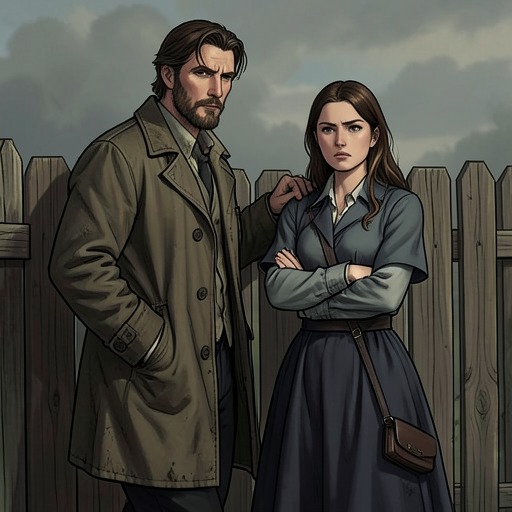
Alec’s proposal to Tess is rejected
Tess of the d'UrbervillesAlec’s proposal to Tess is rejected at Flintcomb-Ash after he arrives with a marriage licence and casts marriage as a means of making amends for the past. The encounter turns on a decisive disclosure: Tess says she loves another man and, when pressed to explain, tells Alec that she is already married. He tears the licence in two, abandoning this attempt to bind her to him, while the scene leaves her marriage and her wish to be treated as a stranger between them.
Background and the Offer
Alec approaches Tess while she is working in the field, trimming swedes near a labourer operating a slicer. He glances around to make sure he will not be overheard and positions himself to screen her from the worker. The setting makes the proposal a private interruption of her labour, though not one wholly removed from the farm’s working life: the machine continues moving nearby, and Tess keeps her hands at work as she listens.
Alec begins by acknowledging that Tess’s material circumstances are harder than they were when he knew her at Trantridge. He says that, when they last met, he had been thinking of their souls and had failed to ask about her worldly condition; her present hardship, he allows, may be partly his responsibility. Tess does not answer. With her head bent and her face hidden by her hood, she continues picking up and trimming the roots, using the regularity of the work to keep him outside her emotions.
He then describes the circumstances behind his offer: his mother has died, the property is now his, and he intends to sell it and devote himself to missionary work in Africa. He presents marriage as the only reparation he can make for what he calls the wrong done to Tess, asking her to become his wife and accompany him. He says that his mother’s dying wish has already enabled him to obtain a marriage licence. The parchment, produced from his pocket with an embarrassed fumbling, turns his proposal from a hypothetical promise into an immediate practical possibility.
Refusal and Disclosure
Tess rejects the offer at once, starting back and telling him no. Alec asks whether she will marry him and make him a self-respecting man; Tess answers that she cannot. When he asks why, she first refuses to explain, insisting that she will never marry him. Her brief declaration that she loves somebody else astonishes Alec, who challenges whether moral propriety has any weight for her.
Alec’s insistence pushes Tess into revealing more than she intended. When he claims that honour requires an explanation, she tells him that she has married the man she loves. She immediately asks Alec not to question her further: the marriage is a secret, or at least only dimly known at the farm, and the two of them, she reminds him, are now strangers. The disclosure explains why the proposal cannot succeed, but it also marks a boundary Tess wants to preserve. She had not meant to tell him, and her appeal is not an invitation to discuss her husband or her past.
The exchange changes the balance of the scene. Alec had arrived presenting himself as a possible benefactor and a penitent seeking to repair an earlier wrong; after Tess reveals her marriage, the same offer is exposed as incompatible with the life she has chosen. Her refusal does not depend on whether Alec can provide security or on whether his plans for Africa are sincere. She says she loves someone else, and that fact is enough to deny his request.
The Licence and the Retreat
Alec reacts to the revelation by repeating that she is married. He then tears the licence slowly into halves and puts the pieces in his pocket. The gesture ends the proposal materially as well as verbally: the document that had seemed to prepare their marriage is destroyed, and Alec acknowledges that the marriage he hoped for has been prevented.
He nevertheless offers to do good for Tess and her husband, whom he says he would like to know so that he might more easily benefit them. Tess tells him that her husband is far away. Alec questions what kind of husband would be distant from her, but the immediate proposal has already collapsed. Tess’s answer supplies one fact about the marriage while withholding the private story behind it; her request to be left alone with that story has not made Alec’s concern disappear.
The action therefore ends in withdrawal, not reconciliation. Alec’s offer begins as an apparent act of restitution, complete with a concrete document and a stated future in missionary work, but Tess refuses its terms. His destruction of the licence confirms the reversal, while his subsequent wish to help her and her absent husband keeps the encounter open as a source of further tension rather than resolving their relationship.
Significance
The proposal brings together economic hardship, past injury, and the unequal power to define what counts as reparation. Alec explicitly connects Tess’s difficult circumstances to his own earlier conduct, yet the remedy he offers would make her his wife and take her away with him. His language of duty and restitution thus does not alter the fact that Tess must decide whether to accept a future arranged by the man who caused the harm she is being asked to forgive.
Tess’s fieldwork gives the refusal a physical counterpoint to Alec’s persuasive speech. She keeps trimming the swedes, her face screened by her hood, and later steps over the newly ploughed furrows without taking the hand he offers to help her. These actions do not replace her spoken refusal; they sustain it in the scene’s gestures. Alec approaches, explains, and offers, while Tess continues working and declines both his marriage proposal and his offered assistance across the earth-rolls.
The disclosure of her marriage makes the encounter especially consequential. Tess wants the fact kept quiet and asks Alec to remember that they are strangers, but her answer reveals the attachment and commitment that govern her choice. The licence’s destruction closes one immediate path, yet Alec’s questions about her absent husband and his continuing offer of help show that the refusal does not end his involvement. The scene is a failed proposal and a clear assertion of Tess’s preference, but not a final escape from the history connecting them.